
 English
  русский
 عربى
عربى
Industry News
Home / Blogs / Industry News / A Complete Guide to Plastic Water Bottle Caps: Types, Sizes, Materials
Content
Ordering plastic water bottle caps looks straightforward until a new SKU starts leaking in transit or jams the capping turret. In practice, a cap is a precision component: its neck finish, thread geometry, liner, and dispensing features determine how fast the bottle runs on the line, whether it survives distribution, and whether consumers can open and reseal it comfortably. This guide covers the cap styles worth considering, the specifications that actually matter, and the checks to run before you commit to a supplier.
Plastic water bottle caps look like simple parts, but they carry four distinct responsibilities: sealing the product for months, proving the pack has not been opened, letting consumers open and reseal without effort, and running at high speed on a filling line. When any one of these fails, the cost shows up as leak complaints, returns, or production downtime.
The conclusion is straightforward: the cap is part of the bottle's engineering, not an add-on. The neck finish, thread pitch, sealing surface, and dispensing geometry all interact with the bottle design, the capping machine, and the way consumers use the product. That is why the same cap style can perform perfectly on one project and cause endless trouble on another.
For water, three cap families cover the great majority of commercial projects. Each one changes the user experience, the filling behavior, and the bill of materials in different ways.
Standard screw caps are the default for still water. A 28mm cap paired with a PCO 1810 neck finish offers a proven seal, wide supplier availability, and low material cost, making it the most reliable option for high-speed filling. Many brands start with 28mm water bottle caps and tune application torque to match their capping heads.
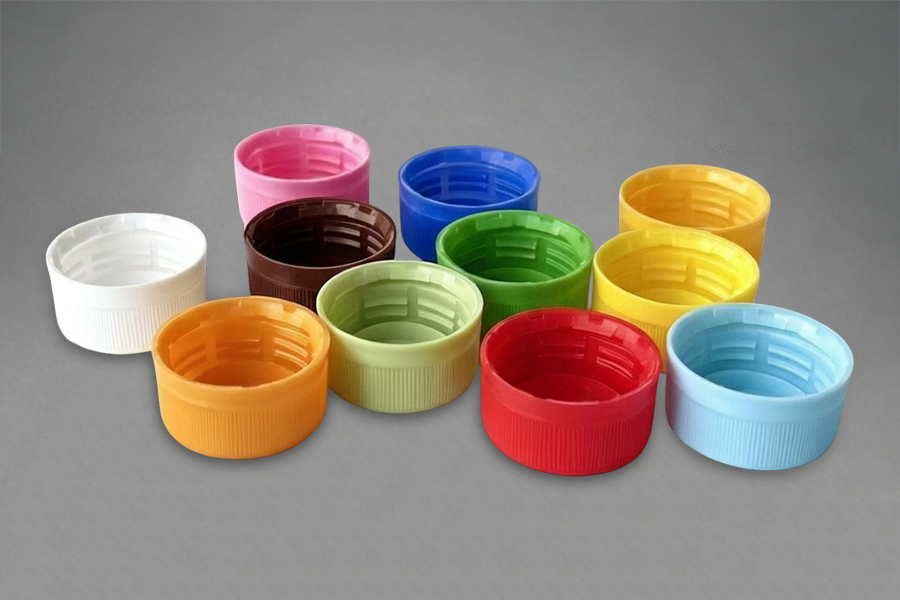
 28mm Plastic Tamper-Evident PCO Water Bottle Caps SupplierLile (Taizhou) Technology Co., Ltd is a China 28mm plastic tamper-evident PCO water bottle caps supplier and factory, matching food-grade PCO 1810 neck finishes for high-speed filling lines.View Product
A 30mm cap creates a larger opening, which noticeably changes pouring and drinking behavior. It suits water brands that encourage adding ice or flavor drops, and it simplifies filling when the product contains larger particulates. Wide-mouth formats also help reusable bottles stay easier to clean. The trade-off is slightly higher material weight per cap, which matters when sustainability targets are measured in grams of plastic per pack. For such projects, 30mm water bottle caps are a common middle ground between pour speed and material consumption.
30mm Plastic Tamper-Evident Water Bottle Caps Supplier, FactoryLile (Taizhou) Technology Co., Ltd is a China 30mm plastic tamper-evident water bottle caps supplier and factory, fitting large-diameter necks for faster pour and easier filling.View Product
Sports pop-up caps use a push-and-pull valve: the consumer lifts the stem to drink and pushes it down to reseal, without removing the cap from the bottle. This format supports one-hand operation and better spill resistance, which is why it dominates gym bottles, children's packs, and outdoor events. The additional moving parts mean more attention to material stiffness and valve geometry during development, but the user experience is hard to beat on the go. Sports pop-up water caps are worth evaluating whenever convenience is the core selling point.
 Sports Pop-Up/Push-Pull Plastic Water Bottle Caps SupplierLile (Taizhou) Technology Co., Ltd is a China sports pop-up plastic water bottle caps wholesale supplier and factory, offering push-pull valve closures for on-the-go hydration.View Product
| Cap style | Typical finish | Opening experience | Best suited for | Watch-out |
| Standard screw | 28mm PCO 1810 | Twist open, twist reseal | Still water, high-volume lines | Torque must match the capping machine |
| Wide-mouth screw | 30mm and larger | Bigger opening, faster pour | Ice, juice blends, reusable bottles | Higher weight per cap |
| Sports pop-up | Push-pull valve | Lift and drink, push to close | Gym, outdoor, children's packs | More parts to test and clean |
| Flip-top | Integrated hinge | Flip open, snap shut | Refillable and premium formats | Hinge wear over repeated cycles |
The neck finish is the precise geometry machined around the bottle mouth, and it is the first thing to verify. A cap built for a PCO 1881 finish will not seal correctly on a PCO 1810 bottle, even though both look similar at a glance. Both finishes accept a cap of roughly 28mm outer diameter, but they differ in opening size, thread profile, and sealing surface. The difference decides flow rate and line compatibility, so the cap and the bottle must be designed as one system. Read the practical comparison of PCO 1810 versus PCO 1881 bottle cap finishes before fixing your specification.
Polypropylene (PP) is the dominant resin for water bottle caps because it balances stiffness, sealing behavior, and food-contact compliance. A cap can use a separate liner for extra barrier performance or a linerless plug seal that relies on the interference between the cap and the neck. The choice depends on your shelf-life target, the gas barrier you need, and whether the line applies a foil seal. Whatever you choose, the material must pass food-contact regulations for every market you ship to.
The band below the cap, connected by breakable bridges, gives consumers visible proof that the bottle was not opened before purchase. Beyond that, tethered caps are now a legal requirement in the EU for beverage containers up to three liters, and similar rules are spreading to other regions. This changes cap design because the retaining strap must survive repeated openings without breaking. Keep current with tethered cap regulations and their engineering impact if you export to regulated markets.
A short qualification process prevents most cap-related line problems and returns. Work through these steps with a real bottle sample and your own filling conditions.
The most expensive cap is the one that fails after filling. These mistakes come up repeatedly in water bottle projects.
Both are neck finishes used with caps around 28mm in outer diameter. PCO 1810 has a narrower opening and is common for still water, while PCO 1881 offers a larger opening and higher flow. The bottle and cap must use the same finish code to seal correctly.
Match the cap to the bottle neck you already have or intend to mold. A 28mm format keeps material usage low and line speed high; a 30mm format gives a better pour and easier cleaning. Consumer habit and filling equipment should drive the decision rather than preference alone.
Polypropylene caps are recyclable in most programs that accept rigid plastics, and tethered designs help keep them attached to the bottle for recycling. Confirm the collection rules in your target markets and avoid mixed-material caps if recyclability is a stated goal.
Every water bottle project brings different constraints: line speed, distribution route, consumer group, and export regulations. A cap manufacturer that has engineered closures for still water, sports drinks, and aseptic carton packaging can shorten the trial-and-error phase considerably. Send your bottle sample and filling conditions to our team for specification feedback, or use the contact page to start the conversation.
If you have any questions, please fill out the contact form at the bottom of the page and contact us.
© Lile (Taizhou) Technology Co., Ltd.
Toudao Town, Taizhou City, Zhejiang Province, China.
liletz@163.com
+8613706571648