
 English
  русский
 عربى
عربى
Industry News
Content
- 1 What Makes a Bottle Cap Suitablefor Aseptic Carton Packaging?
- 2 It Is More Than Just a Tight Fit
- 3 What Aseptic Carton Packaging Actually Requires from a Cap
- 4 The Six Core Features That Define a Suitable Aseptic Cap
- 5 Material Standards and Regulatory Compliance
- 6 How the Clip-On Design Supports Aseptic Integrity
- 7 Carton Format Compatibility
- 8 Line Compatibility and Automated Application
- 9 Quality Control Standards Buyers Should Expect
- 10 Frequently Asked Questions
Industry Insight
What Makes a Bottle Cap Suitable
for Aseptic Carton Packaging?
A technical guide for food and beverage manufacturers evaluating closure systems.
01
It Is More Than Just a Tight Fit
Not every bottle cap can work on an aseptic carton. A cap used in aseptic packaging must meet a specific combination of requirements - sterility compatibility, mechanical precision, material safety, and re-closure reliability - that standard screw caps or snap caps are not designed to deliver. Getting this wrong can compromise the entire shelf-life promise of the product inside.
This article breaks down exactly what separates a cap that is genuinely suitable for aseptic carton packaging from one that is not, covering material standards, design mechanics, and carton compatibility requirements.
Aseptic packaging creates a commercially sterile environment inside the carton. The cap must not reintroduce contamination during or after filling - which places demands on both the cap material and its application method.
02
What Aseptic Carton Packaging Actually Requires from a Cap
Aseptic packaging processes sterilize the product and the packaging separately, then combine them in a sterile environment. The result is a sealed carton that can store liquid food - juice, dairy, plant-based beverages, soups - at ambient temperature without preservatives, typically for 6 to 12 months.
The closure system on that carton carries a specific responsibility. It must:
- Maintain the hermetic seal established during filling - no oxygen or microbes in
- Survive the sterilization treatment applied to the carton surface before or during application
- Allow reliable tamper evidence so consumers and retailers can detect first opening
- Re-seal the package tightly after opening to protect remaining product
- Be compatible with high-speed automated filling lines without causing stoppages
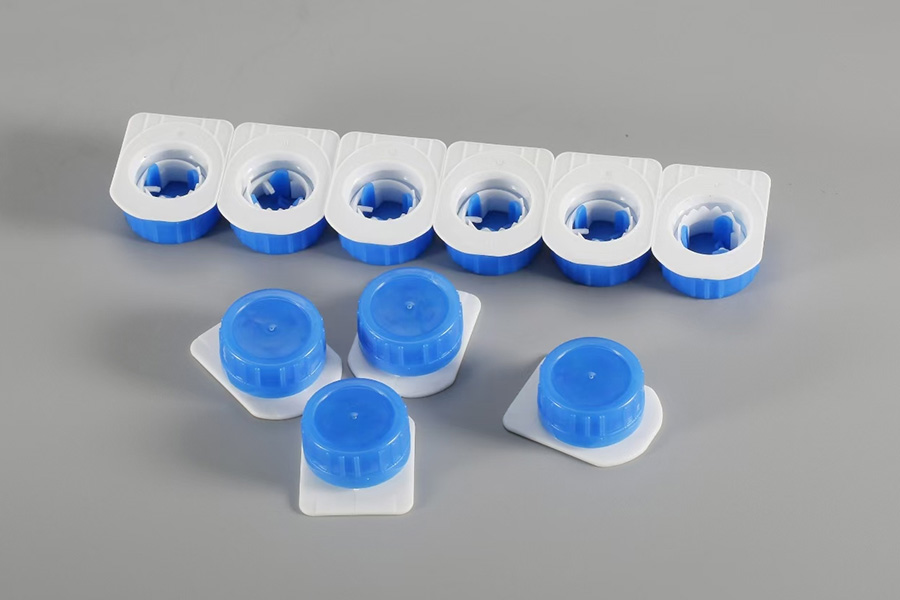
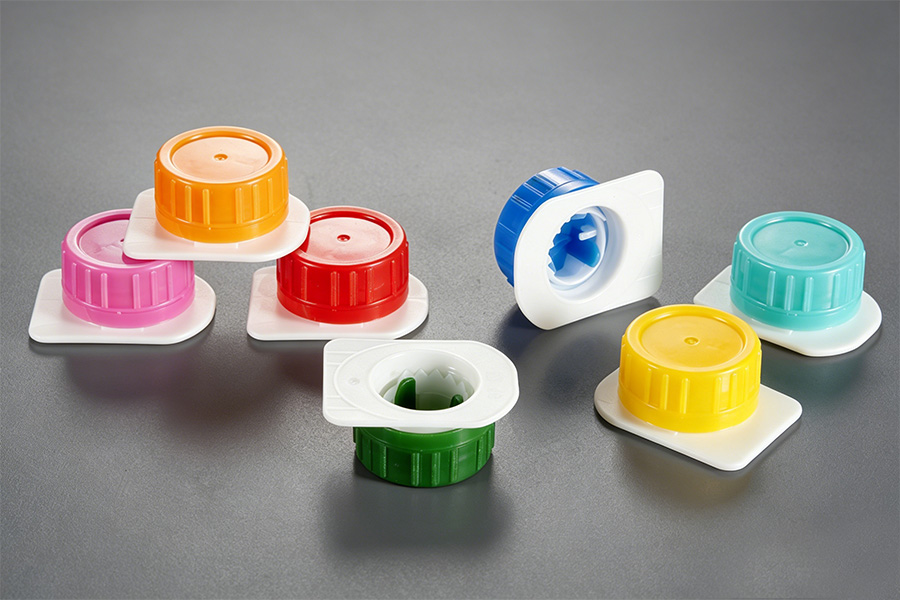
A clip-on cap designed for aseptic cartons addresses all five demands through its material selection, inner valve geometry, and the precision of its collar fit onto the carton spout.
03
The Six Core Features That Define a Suitable Aseptic Cap
When evaluating whether a plastic cap is appropriate for aseptic carton use, these are the factors that matter most:
Food-Grade Material
No plasticizers, heavy metals, or migrants exceeding regulatory thresholds.
Hermetic Inner Seal
A precision inner valve that holds the sterile barrier until first use.
Re-Closure Function
Screw thread or snap mechanism that restores a tight seal after opening.
Tamper Evidence
A tamper-evident ring or bridge that breaks visibly on first opening.
Dimensional Precision
Collar tolerances matched exactly to the carton spout specification.
Process Compatibility
Stable under hydrogen peroxide or UV sterilization without deformation.
04
Material Standards and Regulatory Compliance
The plastic used in an aseptic cap is not a cosmetic choice. It directly affects food safety. The two most common material choices are HDPE (high-density polyethylene) and PP (polypropylene), both accepted under major food contact regulations globally.
Key Regulatory Frameworks
| Regulation | Region | Scope |
| EU Regulation 10/2011 | European Union | Plastic food-contact materials; migration limits |
| FDA 21 CFR 177 | United States | Polymers approved for food contact use |
| GB 4806.7 | China | National standard for plastic food-contact materials |
| BRCGS Packaging | Global | Packaging manufacturing safety and quality certification |
Beyond the base polymer, the colorants, stabilizers, and processing aids added during cap manufacturing must also comply. A cap that passes base resin testing but uses non-compliant pigments is still a food safety risk.
Documentation Tip: Always request a full Declaration of Compliance (DoC) and migration test report from your cap supplier - not just a material data sheet. These are different documents and both are needed for a complete compliance file.
05
How the Clip-On Design Supports Aseptic Integrity
Clip-on caps are particularly well suited to aseptic carton lines because they do not require rotational torque during application. The cap is pressed directly onto the pre-formed carton spout, allowing faster application speeds and eliminating the mechanical complexity of a torque-controlled screw-cap applicator.
The Inner Valve Mechanism
Inside a clip-on aseptic cap sits a cross-cut or star-cut silicone or LDPE valve. In its resting state the valve is fully closed, maintaining the hermetic barrier. When the consumer applies downward pressure or inserts a straw, the valve petals flex open to allow liquid flow, then return to the closed position when pressure is released. This means no separate inner seal needs to be peeled or punctured, which simplifies the opening experience while keeping the barrier intact until the moment of use.
The Collar and Retention Ring
The outer collar of the clip-on cap snaps over a raised retention ring on the carton spout. The dimensional tolerance between the cap collar and the spout ring is critical - too loose and the cap can be dislodged in transit; too tight and application forces risk deforming the carton neck at high line speeds. Well-designed aseptic clip-on caps are engineered to a specific pull-off force specification that balances retention with application reliability.
06
Carton Format Compatibility
Aseptic cartons are produced in a range of formats and sizes. The cap spout geometry differs between carton families, and a cap designed for one format is not necessarily interchangeable with another. Clip-on aseptic caps are validated for the following standard carton formats:
BRIK FINO SLIM PRISMA base 100B 125 SLIM 200 SLIM 330 SLIM 150ml PRISMA 200ml PRISMA 250ml PRISMA 330ml PRISMA 1000ml PRISMA
When sourcing clip-on aseptic caps, manufacturers must confirm that the cap specification explicitly references the target carton format - not just a generic neck diameter measurement. A difference of 0.3mm in collar bore can mean the difference between a secure seal and a failed line trial.
| Carton Family | Typical Volume Range | Key Cap Spec to Confirm |
| SLIM | 125ml - 330ml | Collar bore, retention ring engagement depth |
| PRISMA | 150ml - 1000ml | Spout OD, pull-off force, valve flow rate |
| BRIK / FINO | 100ml - 500ml | Flange seating, tamper-evidence ring geometry |
07
Line Compatibility and Automated Application
A cap that passes all material and dimensional checks still needs to work reliably at production speeds. Aseptic filling lines typically run at 4,000 to 12,000 packs per hour depending on the format, which leaves very little tolerance for cap handling errors, jams, or misalignment.
- Cap orientation: Clip-on caps must be consistently oriented in the hopper feed. Cap geometry that allows random orientation leads to jams at the applicator head.
- Application force consistency: Cap stiffness must be uniform batch-to-batch. Variation in HDPE melt flow index between production lots affects snap-on force and can require line retuning.
- Static electricity: Plastic caps in high-speed vibratory feeders can generate static, causing caps to cluster or stick. Anti-static treatments address this.
- H2O2 sterilization compatibility: Many aseptic lines treat the spout area with hydrogen peroxide before capping. The cap material must withstand brief H2O2 exposure without discoloration or swelling.
08
Quality Control Standards Buyers Should Expect
When sourcing aseptic clip-on caps at scale, the supplier's quality management system is as important as the cap specification itself. Inconsistent cap quality is one of the most common sources of aseptic line failures - and the costs of a line stoppage or a product recall far exceed any savings made on cap unit price.
Minimum Quality Documentation to Request
- Declaration of Compliance (DoC) under applicable food contact regulations
- Migration test reports for the finished cap, not just the base resin
- Dimensional inspection reports with Cpk values for critical cap dimensions
- Pull-off force test data matched to the target carton spout
- AQL sampling plan documentation for incoming and outgoing inspection
- ISO 9001 or equivalent quality management certification
Best Practice: Request a trial shipment of 50,000 to 100,000 caps before committing to full production volumes. Run these on your actual filling line under normal operating conditions and measure application success rate, pull-off force consistency, and seal integrity before approving the supplier.
Frequently Asked Questions
Can a standard screw cap be used on an aseptic carton instead of a clip-on cap?
In most cases, no. Standard screw caps require a threaded spout, and aseptic carton spouts are typically designed for clip-on or press-fit closures. Using a mismatched cap type risks an incomplete seal and compromises the aseptic barrier. Always confirm cap-to-spout compatibility with the carton manufacturer before selecting a closure system.
What is the difference between HDPE and PP for aseptic caps?
Both materials are food-safe and widely used. HDPE is slightly more flexible, which can make snap-on application easier at lower forces. PP has higher rigidity and heat resistance, which can be advantageous if the cap is exposed to elevated temperatures during sterilization. The best choice depends on your specific filling line conditions and carton spout geometry.
How do I know if a cap is compatible with my specific carton format?
Request the cap supplier's compatibility matrix, which should list each carton format and spout specification the cap has been validated against. Do not rely on general diameter measurements alone - the retention ring profile, flange geometry, and seating depth all need to match. A physical fit test on sample cartons is always recommended before production approval.
Does the cap need to be sterilized separately before application?
This depends on the filling line design. Some aseptic lines sterilize the cap as part of the capping process using hydrogen peroxide misting or UV treatment. Others require pre-sterilized caps supplied in sealed bags. Confirm your line's capping module specification with your equipment supplier to determine the correct cap supply format.
What pull-off force should an aseptic clip-on cap have?
Pull-off force requirements vary by cap size and carton format, but a typical range for aseptic carton clip-on caps is 30 to 80 Newtons. Too low and the cap can be removed unintentionally during transport or stacking; too high and consumer opening becomes difficult. Your cap supplier should provide pull-off force test data specific to the target carton spout.
Are clip-on aseptic caps recyclable?
HDPE and PP caps are technically recyclable and accepted in many municipal recycling streams. Recyclability in practice depends on local infrastructure and whether the cap is separated from the carton. Cap manufacturers increasingly offer caps made from recycled PP or HDPE content. Request recyclability documentation from your supplier if sustainability claims are important for your product positioning.