
 English
  русский
 عربى
عربى
Quick Answer: The Main Types of Plastic Bottle Caps
Plastic bottle caps fall into six primary categories: screw caps (the most common), snap-on caps, flip-top caps, disc-top caps, sports caps, and child-resistant caps. Each is engineered for a specific combination of container type, liquid viscosity, dispensing method, and safety requirement. Understanding these differences helps manufacturers, recyclers, and consumers make better decisions.
Screw Caps — The Universal Standard
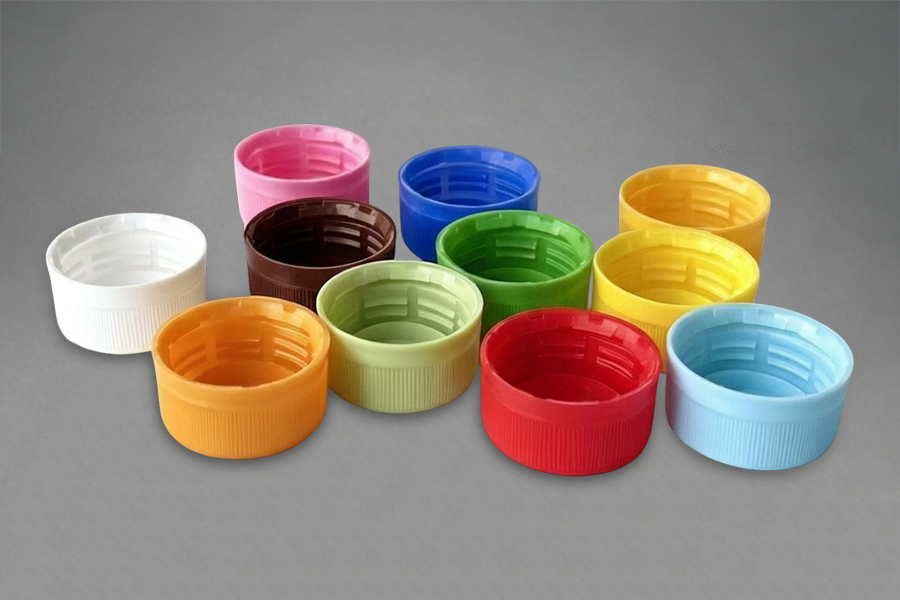
Screw caps, also called threaded closures, account for over 60% of all plastic bottle caps produced globally. They work by engaging a continuous or interrupted thread on the bottle neck (GPI/SPI thread finish) and are sealed by rotating the cap a precise number of turns — typically 360° to 720°.
Key Sub-Types
- Continuous Thread (CT): The most common variant, featuring an unbroken helical thread. Used on water bottles, soda bottles, and household chemical containers.
- Interrupted Thread: Has gaps in the thread for faster application on high-speed filling lines — common in food packaging where lines run 600+ bottles per minute.
- ROPP (Roll-On Pilfer-Proof): A metal-and-plastic hybrid variant used for wine and spirits, offering tamper evidence via a breakaway band.
Standard Sizing
Screw caps are measured by diameter and thread count. Common sizes include 28mm (standard water bottle), 38mm (wide-mouth jars), and 48mm (peanut butter-style containers). The "28-410" designation, for example, means 28mm diameter with a 410 thread finish — a universal specification recognized by packaging engineers worldwide.
For a closer look at how to choose between these three sizes, including neck finish codes and filling line compatibility, see our 28mm vs 38mm vs 48mm diameter guide.
Snap-On and Press-Fit Caps
Snap-on caps use a bead-and-groove mechanism — a raised ridge on the cap snaps into a channel on the bottle finish. They can be applied 10–15% faster than threaded closures on automated lines, making them popular for dairy products, juice bottles, and some pharmaceutical vials.
The trade-off is lower torque retention. Snap-on caps are not suitable for carbonated beverages (internal pressure exceeding 30 psi can cause pop-off failure) or for products requiring hermetic seals. They are widely used on milk jugs, yogurt tubes, and single-serve juice cartons.
- Hinged snap caps: Integrate a living hinge, combining snap-on attachment with a flip-open lid.
- Pilfer-evident snap caps: Feature a tamper-evident ring that breaks on first opening.
Flip-Top Caps — Convenience for Frequent Dispensing
Flip-top caps (also called hinged caps or "Yorker" caps) feature a living hinge — a thin section of polypropylene (PP) that flexes millions of times without cracking. The hinge is typically 0.25–0.35mm thick, engineered to survive 30,000+ open/close cycles in stress testing.
These caps are ubiquitous in personal care: shampoo, conditioner, hand soap, and body wash. They are also used in food applications — ketchup, mustard, honey, and salad dressing. The dispensing orifice diameter (commonly 3mm to 8mm) is calibrated to match the product's viscosity, ensuring controlled flow without dripping.
Disc-Top Caps
A specialized variant of the flip-top family, disc-top caps feature a flat disc that slides laterally to open and close an orifice, rather than a hinged lid. They deliver more precise, controlled dispensing and are favored for cosmetic serums, sunscreens, and lotions where minimizing air exposure extends product shelf life.
Sports Caps and Active-Use Closures
Sports caps use a pull-up spout mechanism: the inner tube is pulled upward to open an orifice (typically 4–6mm diameter), and pushed back down to close. They are engineered to provide leak-free sealing at up to 15 psi when closed, suitable for hydration packs, energy drinks, and sports water bottles.
Modern sports caps often incorporate a silicone or TPE (thermoplastic elastomer) valve that opens under lip pressure and reseals automatically — a design called a "bite valve." This eliminates the need to manually push the spout closed and prevents dripping during activity.
- Standard pull spout: Manually operated, used on most commercial sports drink bottles.
- Bite-valve cap: Self-sealing silicone valve, common in cycling and triathlon hydration systems.
- Straw cap: Incorporates an integrated straw — widely used on children's beverage bottles.
Child-Resistant Caps — Safety-First Engineering
Child-resistant (CR) caps are mandated by the U.S. Poison Prevention Packaging Act (PPPA) of 1970 for all prescription drugs, most OTC medications, and certain household chemicals. They must be openable by at least 80% of adults but resist opening by at least 85% of children under 5 years of age — thresholds verified by standardized panel testing.
Mechanism Types
- Push-and-turn: The cap must be pressed down firmly while rotating. The most common CR mechanism — used on most prescription bottles in the U.S.
- Squeeze-and-turn: Two sides must be squeezed simultaneously while the cap is rotated. Common on bleach and solvent containers.
- Align-and-turn: Arrows on the cap and bottle must be aligned before the cap can be rotated — used on some European pharmaceutical formats.
- Locking closure (non-resealable): Tear-off or break-band designs used on unit-dose pharmaceutical packaging.
Beyond pharmaceuticals, CR caps are increasingly used on cannabis products, laundry pods, and concentrated cleaning products as regulatory requirements expand globally.
Specialized and Emerging Cap Types
Tamper-Evident Caps
Tamper-evident (TE) caps integrate a breakaway band or perforated skirt that detaches visibly on first opening. They are now required by FDA regulations for all OTC drug products and are common on food and beverage containers. The broken band provides visual confirmation that a product has not been opened since manufacturing.
Dispensing Pump Caps
Pump dispensers use a piston-and-check-valve mechanism to deliver a metered dose per stroke — typically 0.5ml to 5ml per pump. They are standard in liquid soap dispensers, hand sanitizers, and premium personal care products. The pump body is usually PP or PE, with a stainless steel spring and a glass or ceramic ball as the check valve.
Linerless vs. Lined Caps
Many caps include an internal liner — a disc of foam, cardboard, or foil that creates a hermetic seal. Foam-lined caps (PE foam + aluminum foil) are used for carbonated beverages to retain CO₂. Linerless caps rely on precisely molded sealing ribs on the inner surface to seal directly against the bottle finish — eliminating liner material reduces cap weight by 15–25% and improves recyclability.
Induction-Sealed Caps
Induction sealing uses an electromagnetic induction coil to heat an aluminum foil layer inside the cap, bonding it to the bottle neck after capping. This creates an airtight, tamper-evident seal independent of the outer cap mechanism. It is the dominant sealing method for vitamins, supplements, cooking oils, and premium sauces.
Cap Materials: Comparing HDPE, PP, and LDPE
The three dominant plastics for bottle caps each offer different performance characteristics. Polypropylene (PP) is the most widely used cap material due to its superior chemical resistance, higher melting point (enabling sterilization), and excellent living-hinge performance.
| Material | Resin Code | Melting Point | Best Use | Recyclability |
|---|---|---|---|---|
| Polypropylene (PP) | #5 | 160–170°C | Flip-top, screw, pharmaceuticals | Widely accepted |
| HDPE | #2 | 120–140°C | Milk jugs, household chemicals | Widely accepted |
| LDPE | #4 | 105–115°C | Squeeze bottles, soft dispensers | Limited (drop-off only) |
| PET | #1 | 245–265°C | Rare (mostly for specific finishes) | Widely accepted |
Screw caps dominate global production volumes, but specialty closures are growing rapidly as e-commerce packaging and convenience-focused design drive demand. The global plastic closures market was valued at approximately $43 billion in 2023, with flip-top and sports caps representing the fastest-growing segments at ~7% CAGR.

Recycling Considerations by Cap Type
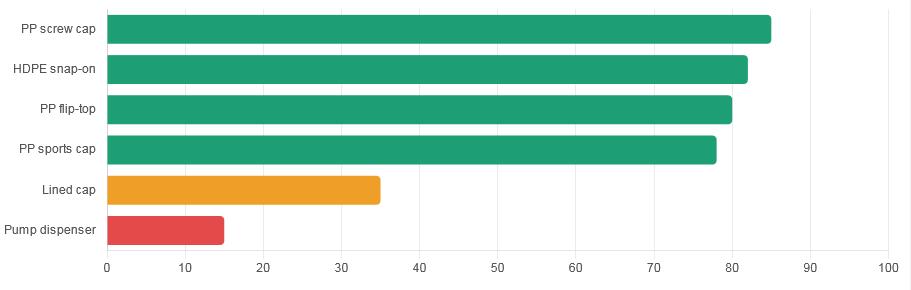
A critical and often overlooked issue: caps and bottles are frequently made from different polymers, complicating recycling. A PET water bottle with an HDPE cap requires separation at the materials recovery facility (MRF). Since 2019, major recycling programs in the U.S. and EU have shifted toward encouraging consumers to leave caps on bottles — modern MRFs can now separate them mechanically.
- PP and HDPE caps are broadly recyclable curbside in most U.S. cities and EU member states.
- Lined caps (foil + foam inner) are technically recyclable but the mixed materials reduce output quality; many MRFs landfill them.
- Pump dispensers contain metal springs and are generally not recyclable — they should be disassembled before disposal where possible.
- Child-resistant caps with multiple components (PP cap + PE insert) can be recycled together if both materials are acceptable at the local facility.
How to Choose the Right Cap Type
Selecting the correct closure involves balancing five factors: product type, dispensing frequency, regulatory requirements, filling line compatibility, and sustainability goals.
| Product Type | Recommended Cap | Key Reason |
|---|---|---|
| Carbonated beverages | Screw cap (CT, lined) | Handles 60–100 psi internal pressure |
| Shampoo / conditioner | Flip-top cap | One-hand dispensing, drip control |
| Prescription drugs | Child-resistant push-and-turn | PPPA legal requirement (U.S.) |
| Sports / hydration drinks | Sports cap / bite valve | One-hand, drip-free during activity |
| Cooking oil | Screw cap + induction seal | Tamper evidence + oxygen barrier |
| Liquid soap / sanitizer | Pump dispenser cap | Metered dosing, no dripping |
| Cosmetic serum / lotion | Disc-top or pump cap | Precise dose, limited air exposure |